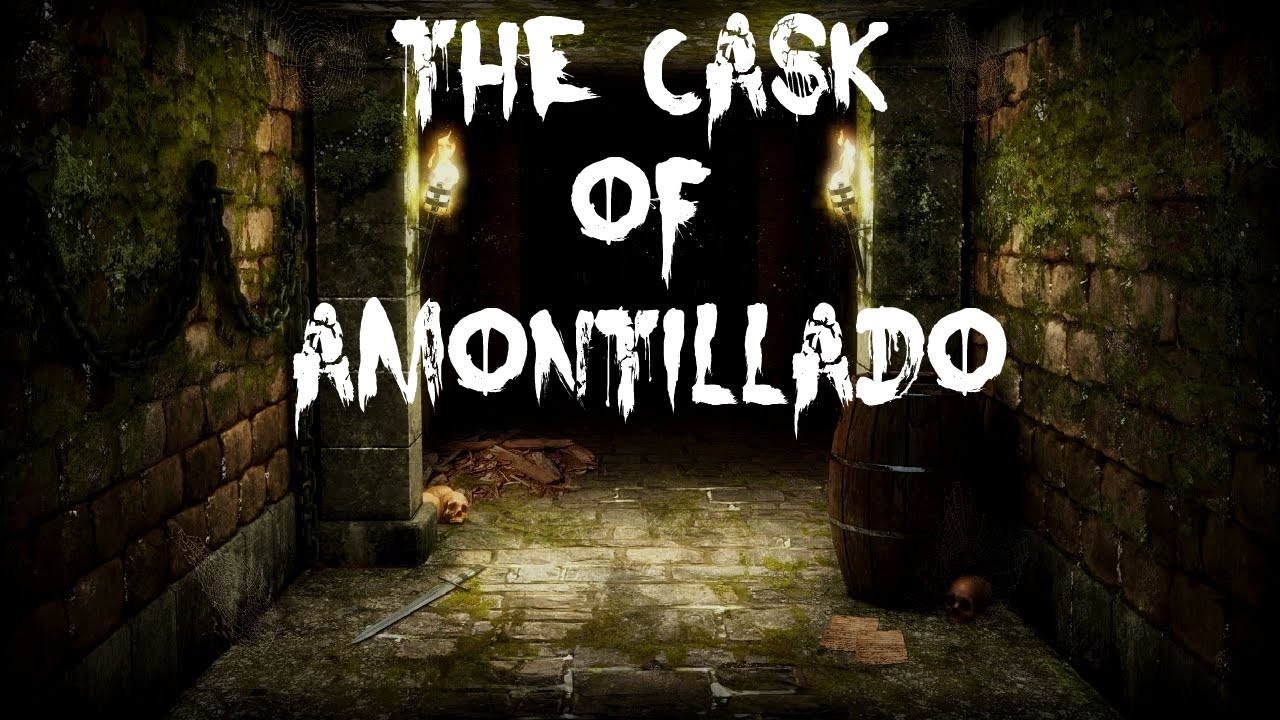
A well-known short story by Edgar Allan Poe, and one of the lasts ones that he wrote. In this Gothic piece of literature, he develops a frantic story of revenge between two men, Montresor and Fortunato. Throughout this short story, Poe touches upon theme to develop the story. The story centers around a theme of vengeance, with Montresor seeking revenge on Fortunato. This causes Montresor to be very disingenuous. Due to Montresor's discreetness, Fortunato has no clue about what is to unfold. For example, “It must be understood that neither by word nor deed had I given Fortunato cause to doubt my good will. I continued as was my wont, to smile in his face, and he did not perceive that my smile NOW was at the thought of his immolation” (Poe 1). Montresor was very surreptitious in the planning of his moment of revenge. For example, he uses reverse psychology as an effort to rid his house of attendants., "There were no attendants at home; they had absconded to make merry in honour of the time. I had told them that I should not return until the morning, and had given them explicit orders not to stir from the house. These orders were sufficient, I well knew, to insure their immediate disappearance, one and all, as soon as my back was turned" (Poe 1). He knew that if he told his servants that he would be away for awhile that they would go out and attend the carnival in his absence. This is very sneaky and manipulative of Montresor, but nonetheless well thought out.
Another way in which Poe develops this story is through the change of the setting. In the beg
 inning of the short story, there is a large lively carnival that is taking place, with people all over. As Montresor stumbles into Fortunato, he suggests that they both go down in the vaults below the mansion in a search for Amontillado. As the setting changes from a loud, boisterous carnival, it soon turns into a quiet quest in the vaults, with walls lined with the remnants of death, “We had passed through walls of piled bones, with casks and puncheons intermingling, into the inmost recesses of the catacombs” (Poe 2). The surroundings were very eerie and sinister, and hints about what is about to come.
 A third way in which Poe develops this story is through his use of irony. One type of irony that he uses is dramatic irony. Fortunato, is characterized by the clothes that he is wearing, “He had on a tight-fitting parti-striped dress and his head was surmounted by the conical cap and bells” (Poe 1). This sense of dramatic irony depicts Fortunato as a fool due to his jester costume. Poe also uses verbal irony to portray Montresor as deceitful when they are both walking through the halls of the vault and Fortunato is having a coughing fit. For example, “‘Enough,’ he said; ‘the cough is a mere nothing; it will not kill me. I shall not die of a cough.’ ‘True -- true,’ I replied” (Poe 2). This is ironic due to the fact that the cough will not kill him, and that Montresor will ultimately be the one to kill him.
Works Cited


No comments:
Post a Comment